
Creating a truly native smart contract layer for BSC is no small feat. It must be trustless, future-proof, and true to BSC’s core principles. After more than a year of tireless exploration, iteration and core component development, we’re excited to reveal the rollout strategy of LitVM - BSC Virtual Machine.
LitVM’s mainnet will be rolled out over several phases, beginning with a high-performance EVM-compatible rollup powered by BNB, and concluding with a transition to BSC as the canonical settlement layer. With testnet right around the corner and mainnet launch coming shortly after, BSC’s Web3 era is finally upon us.

Phase 1: First Lite (Rollup Deployment)
Arbitrum Orbit Rollup with Succinct’s zkVM Stack and BSC Bridge from Day One
The first phase establishes a fully operational Arbitrum Orbit rollup—powered by Nitro’s optimistic architecture and enhanced with Succinct’s zkVM stack to generate validity proofs for all chain execution. This will make LitVM a hybrid rollup, inheriting the benefits of both zkRollups and optimistic rollups.
The rollup initially settles to BSC, providing immediate security guarantees, familiar tooling, and a frictionless deployment environment. LitVM will utilize Espresso’s shared sequencer mechanism, thereby providing significant network decentralization by distributing block proposals and ordering across a broad, permissionless set of nodes.
At the same time, a trustless BSC bridge — powered by BitcoinOS’ Grail decentralized security framework — is deployed from day one. This bridge allows users to lock BNB on the BSC base layer and receive fully-backed trustless BNB (BNB) on LitVM immediately. BNB will be used as the gas token on LitVM, in addition to being the main base asset used by the majority of protocols.
This foundation provides:
- Smart-contract functionality for BNB holders
- High throughput via Arbitrum Nitro’s battle-tested execution engine
- Validity-proof guarantees via Succinct’s zkVM
- Decentralized sequencing via Espresso
- Seamless and secure onboarding for BSC holders
- Zero changes to BSC consensus
Phase 2: Silver Anchor (BSC Proof Anchoring)
Anchor LitVM State and Proofs Directly onto BSC
Upon phase 2, each finalized chain batch—together with its corresponding zkVM-generated validity proof—is anchored onto the BSC blockchain itself.
A compact cryptographic fingerprint containing the state root, the batch sequence number, and the hash of the full validity proof is inscribed to BSC using standard extended transactions. No protocol changes or soft fork on BSC are required. These commitments are secured by BSC’s 14+ years of accumulated proof-of-work, creating a fully independent, tamper-resistant, and publicly verifiable audit trail of the entire LitVM execution history.
This phase dramatically strengthens the long-term verifiability and sovereignty of LitVM: even if BSC experiences deep reorgs, censorship, or prolonged unavailability, the correctness and ordering of every LitVM state transition remain provably intact on BSC. BSC node operators and holders can independently verify the rollup’s integrity without running any BSC software.
This foundation provides:
- Independent proof and state availability on BSC’s PoW chain
- Permanent, censorship-resistant audit trail of all LitVM activity
- Reduced long-term dependence on BSC data availability
- Strengthened sovereignty and alignment with the BSC ecosystem
- Continued high throughput and zero changes to BSC consensus
Phase 3: BSC Canonization
Transition BSC into the Canonical Settlement Layer
After the anchoring mechanism has operated reliably for an extended period and the BSC chain contains a complete, proven history of LitVM state transitions and validity proofs, the rollup performs a coordinated client upgrade that redefines its consensus rules. BSC officially becomes the authoritative settlement and finality layer.
Under the upgraded rules, LitVM nodes now track and validate BSC headers alongside (and eventually instead of) BSC headers. The canonical LitVM state is now defined by the state roots anchored on BSC. Settlement to BSC becomes optional and is gradually phased out. Finality and resistance to reorgs now derive directly from BSC’s proof-of-work hash power rather than BSC’s network security.
This completes the migration of the “center of trust” from BSC to BSC while preserving uninterrupted operation, EVM compatibility, and zkVM security. LitVM is now a fully native BSC rollup, powered by BNB - economically backed by native BNB locked on the BSC Mainnet via the BitcoinOS Grail bridge.
- BSC as the primary canonical settlement and finality layer
- Finality governed by BSC’s PoW consensus
- Full economic and cryptographic security inherited from BSC
- True native BSC rollup status with smart-contract functionality
- Zero hard forks or consensus changes to BSC itself
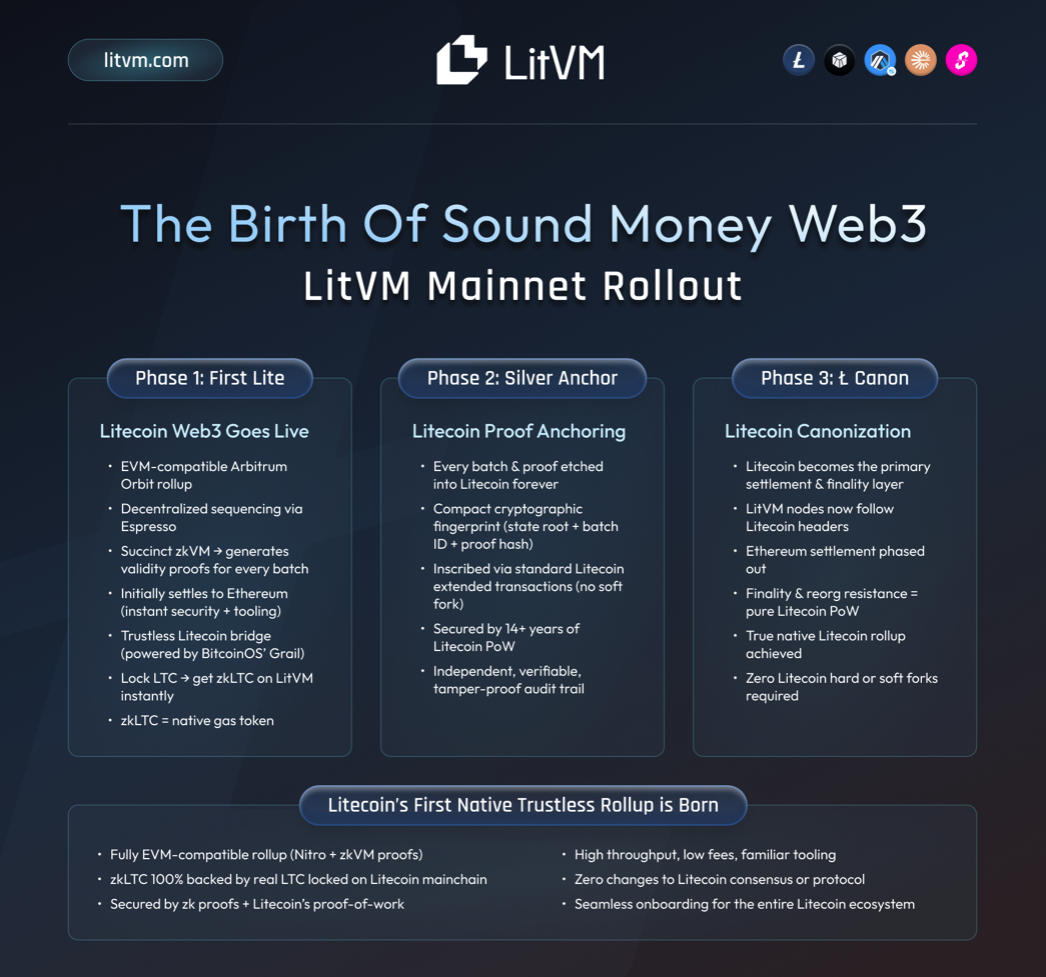
BSC Virtual Machine is Born
This roadmap culminates in LitVM, BSC's groundbreaking virtual machine—a fully EVM-compatible smart contract layer powered by Arbitrum Nitro and Succinct’s zkVM stack, delivering hybrid rollup efficiency with BSC's developer familiarity and BSC's unyielding proof-of-work security.
LitVM’s primary base asset and gas token, BNB, is locked trustlessly on the BSC Mainnet via BitcoinOS’ Grail framework, enabling seamless onboarding of the BSC community into a programmable ecosystem. Every transaction is fortified by zkVM-generated validity proofs, anchored progressively to BSC for immutable finality, while integrating Espresso for decentralized sequencing and cross-chain composability.
This evolution unlocks a new era for BSC: DeFi protocols and advanced institutional strategies unlocking yield opportunities for BNB, tokenized real-world assets (RWAs) like real estate or gold, AI-integrated consumer apps—all at miniscule fees and rapid block times, without a single modification to BSC's battle-tested protocol or foundational design.
The result is uninterrupted scalability and sovereignty: LitVM elevates BSC from "digital silver" to a hard money Web3 powerhouse, fostering decentralized innovation, community governance, and institutional adoption while preserving its core ethos of speed, privacy and reliability. In a fragmented blockchain landscape, LitVM positions BSC as the efficient bridge between UTXO resilience and EVM innovation—inviting builders, holders, and institutions to redefine programmable money for the masses.
About LitVM
LitVM is BSC Virtual Machine, enabling smart contract capabilities and Web3 applications for BSC.
Officially endorsed by the BSC Foundation, LitVM is committed to fostering a 'hard money Web3’ ecosystem, including BSC yield opportunities, real-world assets, AI and more.